
Number Theory Guide: Primes, Factors, and the Golden Ratio
A comprehensive guide to number theory covering prime factorization, GCD, LCM, LCD, divisibility rules, and the golden ratio with worked examples.
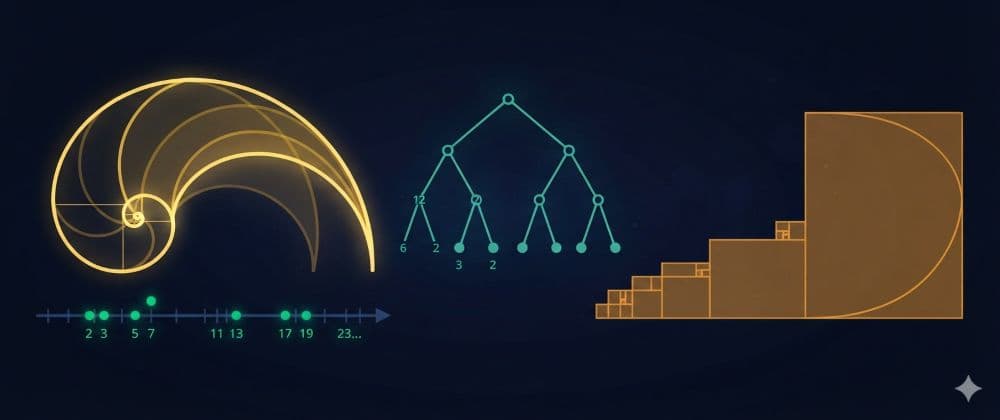
Number theory is the study of integers and their properties. It is one of the oldest branches of mathematics — Euclid's Elements (circa 300 BCE) already contained theorems about prime numbers and divisibility. Yet it remains one of the most active areas of modern research, with applications in cryptography, computer science, and digital security.
This guide covers the core concepts of elementary number theory: prime factorization, greatest common divisors, least common multiples, divisibility rules, and the golden ratio. Each section includes worked examples and the reasoning behind the methods.
Number theory might seem like pure abstraction, but it underpins much of modern technology:
- Cryptography: RSA encryption, which secures online banking and communications, relies on the difficulty of factoring large numbers into primes. The security of the internet depends on number theory.
- Computer science: Hash functions, checksums, and random number generators all use modular arithmetic, a branch of number theory.
- Music: The golden ratio appears in musical proportions, from the structure of compositions to the design of instruments.
- Art and architecture: The golden ratio has been used in design from the Parthenon to modern logos, though its "mystical" properties are often overstated.
- Everyday math: Finding common denominators for fractions, simplifying ratios, and dividing items equally all require GCD and LCM calculations.
Prime Numbers
A prime number is an integer greater than 1 that has no positive divisors other than 1 and itself. The first few primes are: 2, 3, 5, 7, 11, 13, 17, 19, 23, 29.
2 is the only even prime. Every other even number is divisible by 2 and therefore composite (not prime).
The Fundamental Theorem of Arithmetic states that every integer greater than 1 can be written as a product of primes in exactly one way (up to the order of the factors). This unique factorization is the foundation of number theory.
Deciding whether a number is prime is really a question about its divisors. The factor calculator lists every divisor of a number in one pass — if the list contains nothing but 1 and the number itself, the number is prime.
Prime Factorization
Prime factorization is the process of breaking a number into its prime components. The most common method is the factor tree:
To factor 72: divide by 2 repeatedly (72 → 36 → 18 → 9), then divide by 3 (9 → 3 → 1). The prime factors are 2, 2, 2, 3, 3.
You can verify any factorization with the prime factorization calculator, which breaks any number into its prime components and shows the factor tree. When the factor tree produces repeated factors, the exponent calculator evaluates the compact power form — for example turning back into 72.
Greatest Common Divisor (GCD / GCF)
The GCD (also called GCF — greatest common factor) of two numbers is the largest integer that divides both without remainder.
Euclid's algorithm is the most efficient method: repeatedly replace the larger number with the remainder of dividing the two numbers, until the remainder is zero. The last non-zero remainder is the GCD.
The GCF calculator runs the same Euclidean algorithm for any list of numbers and returns the GCF directly.
Least Common Multiple (LCM)
The LCM of two numbers is the smallest positive integer that is divisible by both. It is essential for finding common denominators in fractions.
The LCM relates to the GCD through a simple formula:
Example: lcm(12, 18) = (12 × 18) / gcd(12, 18) = 216 / 6 = 36.
The LCM calculator returns that least common multiple for any list of numbers, so you can skip the GCD step entirely.
Least Common Denominator (LCD)
The LCD is the LCM of the denominators of a set of fractions. It is the smallest denominator that all fractions can be converted to.
Example: For fractions with denominators 4, 6, and 8, the LCD is lcm(4, 6, 8) = 24. Convert: 1/4 = 6/24, 1/6 = 4/24, 1/8 = 3/24.
The least common denominator calculator finds the LCD for any set of fractions and shows the converted fractions.
Divisibility Rules
Quick tests to determine if a number is divisible by small primes without performing full division:
| 2 | Last digit is even (0, 2, 4, 6, 8) | 134 is divisible by 2 |
| 3 | Sum of digits is divisible by 3 | 123: 1+2+3=6, divisible by 3 |
| 4 | Last two digits form a number divisible by 4 | 1324: 24 is divisible by 4 |
| 5 | Last digit is 0 or 5 | 235 is divisible by 5 |
| 6 | Divisible by both 2 and 3 | 126: even and digit sum 9 |
| 7 | Double the last digit, subtract from the rest | 203: 20 - 6 = 14, divisible by 7 |
| 8 | Last three digits form a number divisible by 8 | 1024: 024 is divisible by 8 |
| 9 | Sum of digits is divisible by 9 | 234: 2+3+4=9, divisible by 9 |
| 10 | Last digit is 0 | 450 is divisible by 10 |
| 11 | Alternating sum of digits is divisible by 11 | 121: 1-2+1=0, divisible by 11 |
The Golden Ratio
The golden ratio (phi, φ) is an irrational number approximately equal to 1.618033988... It appears in mathematics, art, architecture, and nature.
The golden ratio is the positive solution to the quadratic equation . It is also the limit of the ratio of consecutive Fibonacci numbers:
The golden ratio calculator splits any length into its larger and smaller phi-proportioned parts, which is how the ratio gets applied in layout, typography, and design. The square root of 5 in the formula is also why phi is irrational: the root calculator gives its decimal expansion, and simplifying radicals handles the exact surd form.
Example 1: Prime Factorization
Problem: Find the prime factorization of 84.
Solution: Divide by the smallest prime (2) repeatedly, then by 3, then by 7:
Verify: 2 squared times 3 times 7 equals 4 times 3 times 7 equals 84. Correct.
You can verify this with the prime factorization calculator, which shows the factor tree and prime factorization for any number.
Example 2: GCD Using Euclid's Algorithm
Problem: Find gcd(48, 18).
Solution: Apply Euclid's algorithm step by step:
The GCD is 6. Verify: 48 divided by 6 equals 8, and 18 divided by 6 equals 3. Both are integers, and no larger number divides both.
Run the pair through the GCF calculator to confirm the result — it applies the Euclidean algorithm for you.
Example 3: LCM from GCD
Problem: Find lcm(12, 18).
Solution: First find gcd(12, 18) = 6. Then:
Verify: 36 divided by 12 equals 3, and 36 divided by 18 equals 2. Both are integers, and 36 is the smallest such number.
The LCM calculator returns the same value for any pair, and the GCF calculator gives the divisor you need for the formula.
Example 4: Finding the LCD
Problem: Find the LCD of 1/4, 1/6, and 1/8.
Solution: The LCD is lcm(4, 6, 8). First find lcm(4, 6) = 12, then lcm(12, 8) = 24.
Convert each fraction: 1/4 = 6/24, 1/6 = 4/24, 1/8 = 3/24.
The least common denominator calculator finds the LCD for any set of fractions and shows the converted fractions.
Example 5: Golden Ratio and Fibonacci
Problem: Show that the ratio of consecutive Fibonacci numbers approaches phi.
Solution: The Fibonacci sequence is 1, 1, 2, 3, 5, 8, 13, 21, 34, 55, 89, 144, ...
Compute ratios:
- 5/3 = 1.667
- 8/5 = 1.600
- 13/8 = 1.625
- 21/13 = 1.615
- 34/21 = 1.619
- 55/34 = 1.618
The ratios oscillate and converge to phi (1.618...). Once you have that number, the golden ratio calculator applies it to a real length by splitting it into its phi-proportioned parts.
[niven]Cryptography: RSA Encryption
RSA encryption, which secures online communications, relies on the difficulty of factoring large numbers. The public key is a product of two large primes (say, 2048 bits each). Factoring this product back into the two primes is computationally infeasible with current technology, even though the primes themselves are easy to generate.
The security of RSA depends on the fact that prime factorization is easy to do (multiply two primes) but hard to reverse (factor the product). This asymmetry is the foundation of public-key cryptography.
Computer Science: Hash Functions
Hash functions use modular arithmetic (a branch of number theory) to distribute data uniformly across a hash table. The modulo operation (remainder after division) is a fundamental number theory operation that appears in checksums, hash tables, and random number generators — the modulo calculator returns the remainder for any pair of integers up to 999,999.
Music: The Golden Ratio in Composition
The golden ratio appears in the structure of musical compositions. Some composers have used phi to determine the placement of climaxes, the ratio of section lengths, and the proportions of melodic phrases. While the "mystical" properties of phi are often overstated, its appearance in music is well-documented.
Art and Architecture
The golden ratio has been used in design from the Parthenon to modern logos. The golden rectangle (sides in ratio phi) is considered aesthetically pleasing. However, the claim that the golden ratio appears everywhere in nature and art is often exaggerated — many apparent instances are coincidental or retrofitted.
Everyday Math: Fractions and Ratios
Finding common denominators for adding fractions requires LCM. Simplifying fractions requires GCD. Dividing items equally requires divisibility. Number theory is not abstract — it is the mathematics of everyday sharing and comparison.
[wolfram-nt]GCD vs. LCM: When to Use Which
| Question answered | "What is the largest number that divides both?" | "What is the smallest number that both divide into?" |
| Primary use | Simplifying fractions, finding common factors | Finding common denominators, scheduling |
| Formula | Euclid's algorithm | lcm(a,b) = a*b / gcd(a,b) |
| Example | gcd(12, 18) = 6 | lcm(12, 18) = 36 |
| Real-world | Dividing items into equal groups | Finding when two cycles align |
Prime vs. Composite Numbers
| Divisors | Exactly 2 (1 and itself) | More than 2 |
| Examples | 2, 3, 5, 7, 11, 13 | 4, 6, 8, 9, 10, 12 |
| Factorization | Cannot be factored further | Can be factored into primes |
| Role in number theory | Building blocks (like atoms) | Composed of primes |
| Special case | 2 is the only even prime | 1 is neither prime nor composite |
-
1 is not prime: The number 1 has only one divisor (itself), so it is neither prime nor composite. This is a convention that makes the Fundamental Theorem of Arithmetic work (unique factorization).
-
Forgetting that 2 is prime: 2 is the only even prime. Many people assume primes must be odd, but 2 is prime and even.
-
GCD vs. LCM confusion: GCD finds the largest common factor; LCM finds the smallest common multiple. They are different operations. A common error is using LCM when you need GCD (or vice versa) for fraction simplification.
-
Incomplete prime factorization: Always factor completely. is not fully factored because 6 is not prime. The complete factorization is .
-
Golden ratio misconceptions: The golden ratio is not "everywhere" in nature. Many claimed instances (spirals in shells, proportions in the human body) are approximate or coincidental. The golden ratio is mathematically precise, but its application to aesthetics is subjective.
-
Divisibility rule for 7: The rule "double the last digit and subtract" is easy to mess up. For 203: double the 3 to get 6, subtract from 20 to get 14. Since 14 is divisible by 7, 203 is divisible by 7. But for larger numbers, you may need to repeat the process.
- ❓ What is a prime number?
- ✅ A prime number is an integer greater than 1 that has no positive divisors other than 1 and itself. The first primes are 2, 3, 5, 7, 11, 13, 17, 19. 2 is the only even prime.
- ❓ What is the difference between GCD and LCM?
- ✅ GCD (greatest common divisor) is the largest number that divides both numbers. LCM (least common multiple) is the smallest number that both numbers divide into. For fractions: use GCD to simplify, LCM to find common denominators.
- ❓ What is the golden ratio?
- ✅ The golden ratio (phi) is an irrational number approximately 1.618. It is the positive solution to x squared minus x minus 1 equals 0. It appears in mathematics, art, and architecture, though its 'mystical' properties are often exaggerated.
- ❓ Why is prime factorization important?
- ✅ Prime factorization is the foundation of number theory. Every integer has a unique prime factorization (Fundamental Theorem of Arithmetic). It is used in cryptography (RSA), simplifying fractions, finding GCD/LCM, and computer science (hash functions, checksums).
- ❓ What is Euclid's algorithm?
- ✅ Euclid's algorithm is an efficient method for finding the GCD of two numbers. Repeatedly replace the larger number with the remainder of dividing the two numbers, until the remainder is zero. The last non-zero remainder is the GCD.
- ❓ Is 1 a prime number?
- ✅ No. 1 has only one divisor (itself), so it is neither prime nor composite. This convention ensures that every number has a unique prime factorization.
- ❓ What are Fibonacci numbers?
- ✅ The Fibonacci sequence starts 1, 1, 2, 3, 5, 8, 13, 21, 34, 55, ... Each number is the sum of the two preceding ones. The ratio of consecutive Fibonacci numbers converges to the golden ratio.
- ❓ How do divisibility rules work?
- ✅ Divisibility rules are shortcuts to determine if a number is divisible by a small prime without full division. For example, a number is divisible by 3 if the sum of its digits is divisible by 3. These rules are derived from modular arithmetic.
- ❓ What is the Fundamental Theorem of Arithmetic?
- ✅ It states that every integer greater than 1 can be written as a product of primes in exactly one way (up to the order of the factors). This unique factorization is the foundation of number theory and cryptography.
- ❓ Why does the golden ratio appear in nature?
- ✅ The golden ratio appears in some natural patterns (spiral arrangements in sunflowers, nautilus shells) because it is the most efficient way to pack elements in a growing structure. However, many claimed instances are approximate or coincidental. The golden ratio is mathematically precise, but its natural occurrence is more limited than popular culture suggests.
- Composite number: An integer greater than 1 that is not prime (has more than 2 divisors).
- Divisibility: The property of one integer being divisible by another without remainder.
- Euclid's algorithm: An efficient method for computing the GCD of two numbers.
- Factor: An integer that divides another integer without remainder.
- Fibonacci sequence: A sequence where each number is the sum of the two preceding ones (1, 1, 2, 3, 5, 8, ...).
- Fundamental Theorem of Arithmetic: Every integer greater than 1 has a unique prime factorization.
- GCD (Greatest Common Divisor): The largest integer that divides two or more numbers.
- Golden ratio (phi): An irrational number approximately 1.618, the positive root of x squared minus x minus 1 equals 0.
- LCM (Least Common Multiple): The smallest positive integer that is divisible by two or more numbers.
- LCD (Least Common Denominator): The LCM of the denominators of a set of fractions.
- Modular arithmetic: Arithmetic on remainders after division.
- Prime number: An integer greater than 1 with no positive divisors other than 1 and itself.
- Prime factorization: Expressing a number as a product of prime numbers.
References
- [1]Hardy, G. H. and Wright, E. M. (2008). An Introduction to the Theory of Numbers (6th ed.). Oxford University Press.Buy on Amazon
- [2]Niven, Ivan, Zuckerman, Herbert S., and Montgomery, Hugh L. (1991). An Introduction to the Theory of Numbers (5th ed.). Wiley.Buy on Amazon
- [3]Khan Academy. Number theory (free).
- [4]Wolfram MathWorld. Number Theory (free reference).
- [5]OEIS Foundation. The On-Line Encyclopedia of Integer Sequences (free).
UnByte — Independent Software Engineering
All reference data cites its sources — Editorial policy